Starting from the question of why, particularly in the realm of sexuality, the modernity of certain groups or societies must be either affirmed or questioned, the research project underlying this lecture examines the entanglements of feminist and queer thought with ideologies of progress. To this end, the concepts of sexuality in various canonical feminist and queer texts in Germany, France, and the U.S. since the 1960s were examined, and three debates that have permanently altered the understanding of sexuality were analyzed: the West Berlin “Tuntenstreit,” the debate over political lesbianism, and the feminist “sex wars.” Drawing critically on Foucault and Freud, feminist and queer authors have articulated the intersection of bodies, language, and knowledge in their writings on sexuality. In each context, this took concrete forms that are regularly shaped by translations and the circulation of knowledge. Neither the national or linguistic spaces nor the temporal framework can be regarded as homogeneous; on the contrary: the lecture highlights the productivity of conflicts in feminist and queer thought.
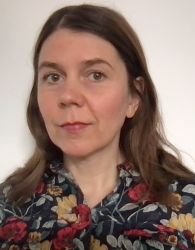
Cornelia Möser is a researcher at the French National Center for Scientific Research (CNRS) at the Center for Sociological and Political Science Research in Paris, where she works in the “Gender, Work, and Mobility” research group. Her postdoctoral thesis, „Libérations sexuelles“, was published in 2022. She has co-edited the anthologies „Paradoxical Right-Wing Sexual Politics in Europe“ and „Avec, sans ou contre. Critiques queer/féministes de l’Etat“: Her most recent articles are „Materialismus im feministischen und queeren Denken“ in the Deutsche Zeitschrift für Philosophie and „Ecofeminism as a Traveling Theory. French and German Perspectives“ in the journal Social Politics. She has been an associate member of the Centre Marc Bloch in Berlin since 2013.
The space is accessible by elevator. There are two accessible restrooms on the first floor (1.G40s and 1.G40h).
There is an all-gender restroom (1.G40n) on this floor with standing and seated toilets. There is also a FLINTA* restroom (2.G40q) on the 2nd floor of the CGC.
The CGC strives to ensure the best possible accessibility for its events. If you require assistance to participate in our event, please let us know your support needs by May 27, 2026, via email to cgcentrum@soz.uni-frankfurt.de. We will then do our best to mitigate any barriers within our capabilities.
You are welcome to attend this event with your children. Please contact us at the email address above by May 27, 2026, if you would like us to arrange childcare as well. We look forward to your participation.